The black line around a photograph is not decoration. It is a machine tolerance made visible. Every rebate, every rounded corner on a perforation, every millimeter of clear film between two frames was engineered to solve a mechanical problem: how to move a flexible strip past a lens with micron accuracy, expose it, and move it again, 24 or 36 times a minute, for a century. When you print full-frame and leave the edges intact, you are printing the solution.
This is a walk through that solution, format by format, measurement by measurement, from Dickson's 1892 Edison workshop up through IMAX 15/70 and the Minox strip narrower than a pencil. Dimensions here come from SMPTE, ISO, and Kodak primary standards. Where sources disagree, I've flagged it rather than papered over it.
Quick take: film borders are the fossil record of mechanical engineering. 35mm's 8-perforation still frame, 120's paper-backed openness, 9.5mm Pathé's lonely center sprocket, and IMAX's horizontal 15-perforation monster are not arbitrary. Each one solves a specific problem of registration, economy, or exhibition. Learn to read those borders and a contact sheet becomes a forensic document: format, emulsion, even decade, all legible from the geometry alone.

Diagram: 35mm film common formats (Wikimedia Commons, CC BY-SA 3.0).
Why borders exist: registration, pitch, and the tyranny of the claw
Before 1889 there was no border because there was no film. George Eastman's roll-film coating process met the demand Edison's laboratory was about to create, and in 1891–92 William Kennedy Laurie Dickson cut Eastman's 70-millimeter stock in half, punched four rectangular holes on each side of every frame, and set a standard that has governed the moving image for more than 130 years. Edison's choice of 35mm width and four perforations per frame was ratified at the 1909 Paris Congress and never meaningfully revisited.
The reason borders became standardized is mechanical. A sprocket wheel turns. Its teeth engage perforations. A pull-down claw grips, yanks one frame's worth of film, and releases while a pressure plate holds the frame still for exposure. Any looseness in that handoff blurs the picture. Any tightness tears the film. The perforation is therefore not a hole. It is a toleranced coupling between a piece of metal and a strip of plastic, and everything around it is clearance.

Edison-style rectangular perforations on 35mm film (Wikimedia Commons).
Those clearances compounded into aesthetic conventions. The rebate (the clear strip between frames on 35mm still film, between images on 120 roll film, or between the picture and the optical sound track on a 16mm release print) exists so the film can be transported without exposing or cutting through emulsion that matters. Photographers later decided this accidental margin was meaningful and began to print it deliberately.
The 35mm family tree: BH, KS, DH, and the fox-hole
The history of the 35mm perforation is the most consequential line of evolution in film. Four distinct shapes compete for the four edges of every motion-picture image, and the difference between them is measured in thousandths of an inch and a century of engineering argument.
The Bell & Howell (BH) perforation, introduced around 1917 by the Chicago camera-maker for its Standard Camera, measures 2.79 × 1.85 mm (0.110 × 0.073 in). Its shape is a barrel: straight top and bottom, outward-curving sides. Until 1989 its corners were sharp. BH perforations are used almost exclusively for camera-original negative and for intermediate stocks, because their tight fit around a registration pin delivers the best possible steadiness. They come in two pitches: BH-1866 at 4.740 mm (short pitch, modern camera negative) and BH-1870 at 4.750 mm (long pitch, historically used for release prints). The 0.010 mm difference is not trivial. It compensates for the different path lengths of negative and print stock when they pass through a contact printer, where the negative rides closer to the sprocket drum and therefore needs shorter pitch.

Lumière-style round perforations on early 35mm film (Wikimedia Commons).
The Kodak Standard (KS) perforation, introduced by Eastman Kodak in 1924, measures 2.79 × 1.98 mm (0.110 × 0.078 in). Taller than BH, with gently rounded corners. The extra height and radiused corners are deliberate: KS perfs survive the repeated jackhammering of projection intermittent movements that would tear BH perfs to shreds. KS is the universal perforation for 35mm release prints, for all 65/70mm applications, and — importantly for still photographers — for every frame of 135-format film you have ever loaded into a camera. When you hand-thread a roll of Portra, the teeth of the take-up sprocket are engaging KS-1870 perforations originally designed for theatrical projection.
Two minor players complete the family. The Dubray-Howell (DH) perforation, proposed in 1932, borrows KS's rounded shape and BH's shorter height; it persists in Kodak's long-pitch interpositive stocks and in Technicolor dye-transfer work. The CinemaScope "fox-hole" (CS-1870), a nearly square 1.98 × 1.85 mm perforation with rounded corners, was introduced in 1953 to free edge real estate for four magnetic sound stripes. CS perforations were never kind to sprocket wheels; CS-equipped prints and machines died with magnetic 35mm sound around 1980.
35mm still: eight perforations, a 2mm rebate, and the DX code
The 135 format (the cassette-loaded 35mm still film standardized in ISO 1007) is an inheritance, not an invention. Its film is 34.98 ± 0.03 mm wide. Its perforations are KS-1870 at 4.750 mm pitch. Its frame is 24 × 36 mm laid horizontally along the film, and it advances exactly eight perforations (38.00 mm) per exposure, leaving a roughly 2.00 mm rebate between frames. Around the perforations on each edge sit about 1.5 mm of margin carrying the manufacturer's edge imprint ("KODAK PORTRA 400"), frame numbers, and — since 1983 — the DX code: a six-by-two grid of silver and clear squares encoding film speed, type, and roll length for automatic cameras. The DX code lives in exactly the strip that makes it into the print when you file out your negative carrier. Photographers who print "full frame" are publishing Kodak's barcode as part of their authorship claim.

35mm film sprocket geometry (Wikimedia Commons).
Cinema apertures: Academy to Super 35, through the widescreen wars
On the same strip of 35mm film, cinema evolved a dizzying set of apertures. Each one is a different way of carving an image out of the available rectangle.
| Format | Year | Camera aperture (mm) | Perfs/frame | Aspect | Perf type |
|---|---|---|---|---|---|
| Silent (full aperture) | 1892 | 24.89 × 18.67 | 4 | 1.33:1 | Edison/BH |
| Academy | 1932 | 22.05 × 16.03 | 4 | 1.37:1 | BH neg / KS print |
| CinemaScope (2.55:1) | 1953 | 23.80 × 18.67 | 4 | 2.55:1 anamorphic | CS-1870 |
| CinemaScope (2.39:1) | 1970 | 21.29 × 17.78 (proj) | 4 | 2.39:1 anamorphic | KS |
| VistaVision | 1954 | 37.72 × 24.92 | 8 (horizontal) | 1.50–1.85:1 | BH/KS |
| Technirama | 1956 | 37.72 × 24.92 + 1.5× | 8 (horizontal) | 2.35:1 | BH |
| Techniscope | 1960 | 22.00 × 9.50 | 2 | 2.33:1 | BH |
| Super 35 (4-perf) | 1982 | 24.89 × 18.66 | 4 | extractable | BH |
| Super 35 (3-perf) | — | 24.89 × ~13.86 | 3 | 1.78:1 | BH |
The Academy aperture (SMPE 1929, revised AMPAS 1932) shrank the silent frame to 22.05 × 16.03 mm to make room for a 2.54 mm-wide variable-area optical sound track along the left edge of the print. Roughly a fifth of the negative surrendered to sound. That tax drove half a century of widescreen experimentation.
CinemaScope (1953) stretched a 2.55:1 or 2.39:1 picture onto a near-square negative using a 2× anamorphic lens, which is why a raw 'scope negative held to the light looks like stretched portrait photographs of tall, thin people. The projector's matching 2× lens un-squeezes the image back to width. VistaVision (Paramount, 1954) went the other way and turned the film sideways. VistaVision runs 35mm horizontally through the camera, right-to-left, advancing eight perforations per exposure, and produces a 37.72 × 24.92 mm frame — nearly the size of a 135 still negative, on the same film width. The perforations, which on a vertical 35mm frame sit on the sides, now sit on top and bottom. The format demanded specialized Century horizontal projectors that almost nobody installed; most VistaVision prints were optically reduced to conventional 4-perf vertical release prints with Perspecta Stereo cues in the optical track. VistaVision lives on as a digital-era special-effects acquisition format and in the recent Panavision renaissance.

VistaVision 8-perf horizontal 35mm (Wikimedia Commons).
Techniscope (Technicolor Italia, 1960) is the poor relation. A 2-perforation pulldown gives 22.0 × 9.5 mm on the negative, a native 2.33:1 aspect, and half the film consumption of a 4-perf frame. It was optically blown up and anamorphosed to a conventional 4-perf 2.35:1 print for release. Techniscope shot much of Sergio Leone's spaghetti-western output and was resurrected in spirit by 3-perf Super 35, which uses the old optical-track strip for image and pulls down three perforations (14.25 mm) per frame to produce a native 1.78:1 negative for digital post. A 25% film-stock saving that matters at feature length.
65/70mm and the IMAX colossus
The widest gauge in commercial cinema is a 5-millimeter wider negative: 65mm camera, 70mm print. The extra 5 mm (2.5 mm per edge) was added to the print to carry four magnetic sound stripes totaling six channels. The perforation is always KS-1870 at 4.750 mm pitch. The Todd-AO / Super Panavision 70 system pulls down five perforations per frame (23.81 mm), yielding a roughly 48.56 × 22.09 mm projection aperture at 2.20:1. Ultra Panavision 70 adds a 1.25× anamorphic squeeze for a 2.76:1 aspect — the ratio of Ben-Hur (1959) and, six decades later, The Hateful Eight (2015).

65/70mm film with 5-perf pulldown (Wikimedia Commons).
IMAX 15/70 turns the 70mm strip sideways, like VistaVision on steroids. The film runs horizontally, pulled by a patented rolling-loop mechanism invented in Australia, and each exposure consumes fifteen perforations (71.25 mm) to produce a frame of 70.41 × 52.63 mm — nearly ten times the area of a standard 35mm frame. IMAX sound is always on separate media: historically a 35mm magnetic dubber, now DTS-style digital synchronized to the picture. The frame is so large that standard 70mm projector optics physically cannot accommodate it. IMAX theaters are IMAX theaters because of the film transport, not just the screen.

IMAX 15/70 film (Wikimedia Commons).
120 and 220: borders without perforations
Leave cinema. Enter Brownie country. 120 roll film (1901) was the first mass-market medium-format, and it has no perforations at all. The film is 60.7 to 61.7 mm wide per ISO 732:2000, protected by an opaque paper backing slightly wider than the film itself, carrying printed frame numbers visible through a red window. Film advance is mechanical counting or red-window reading; registration is done by the camera's gate, not by sprockets. The consequence is a rebate that belongs entirely to the photographer: no clamping holes, no sound stripe, just the clean film edge, the manufacturer's imprint ("ILFORD HP5 PLUS 400") between frames, and whatever fog margin the roll's paper-separation introduces.

127, 135, and 120 film side by side (Wikimedia Commons).
The actual image widths across 120 are all roughly 56 mm. The nominal "6 cm" of "6×7" is marketing; the real figure is the film width minus fog margins.
| Aspect | Frame (mm) | Frames / 120 roll |
|---|---|---|
| 6×4.5 (645) | 56 × 41.5 | 16 |
| 6×6 | 56 × 56 | 12 |
| 6×7 | 56 × 69.5–72 | 10 |
| 6×8 | 56 × 76 | 9 |
| 6×9 | 56 × 84 | 8 |
| 6×12 | 56 × 112 | 6 |
| 6×17 | 56 × 168 | 4 |
220 film (1965–2018) is the same stock, doubled in length, with no backing paper behind the imaging area. Only a paper leader and trailer. That saves spool bulk and gives 24 frames of 6×6 instead of 12, but it makes 220 incompatible with red-window cameras and often requires a different pressure-plate position because the paper is gone from behind the film. Fujifilm ceased 220 production in December 2018; only intermittent Shanghai GP3 runs remain.
The edge-text on a 120 negative, visible when you print with an oversized negative carrier, is a kind of forensic signature. Kodak, Ilford, Fuji, and Foma each print distinct typefaces and frame numberings. A 6×6 contact strip laid flat will tell you the manufacturer without looking at the box.
Sheet film and the notches you read in the dark
At 4×5 inches and larger, film stops being a strip and becomes a stack of individual sheets. 4×5 is actually 101.6 × 127 mm; 8×10 is 203.2 × 254 mm. There are no perforations, no continuous edge markings, no rebate between frames, because there are no "frames" in the serial sense. Each sheet is a discrete object. The margin visible on a processed negative is simply the inner rail of the film holder, usually 3–4 mm wide.
The one border-like feature sheet film retains is the notch code: a pattern of V, U, and square notches cut into one short edge near a corner that identifies the film brand, type, process, and emulsion side in total darkness. The canonical rule, published in Kodak's Technical Publication P7-4A and in Ilford's Notch Codes Guide PDF, is simple: hold the sheet with the notches at the upper right of the top short edge, and the emulsion faces you. Every Kodak, Ilford, Fuji, and Foma sheet-film product has its own notch signature; Tri-X, T-Max 400, HP5+, and Velvia can all be distinguished by fingertip alone. It is the most intimate border in photography. A tactile margin, read with the hand, not the eye.
Cartridge formats: 110, 126, 127, 828, APS, and the disc
Between the roll-film mainstream and subminiature exotica sits a belt of twentieth-century consumer formats in which Kodak repeatedly tried to design the border out of existence, or rather, to hide it inside a plastic cassette so the user never had to think about it.
127 film (1912) was Kodak's first compact roll format: 46 mm wide, paper-backed, and hospitable to 4×4 cm (the "Superslide" size of the Baby Rolleiflex), 4×6.5 cm (the original Vest Pocket Kodak), or 3×4 cm frames. Kodak ended production in 1995; Fotokemika in Croatia carried it through 2012.
126 Kodapak (1963) took 35mm-width film, stripped away the motion-picture perforations, and punched a single square registration perforation per frame that engaged a mechanical stop in the camera. The frame is 26.5 × 26.5 mm square after masking — the square aesthetic of the Sixties snapshot. The asymmetric plastic cartridge is drop-in foolproof. Kodak ended 126 production in 1999; Ferrania in Italy continued briefly.
110 Instamatic (1972) miniaturized the idea: 16 mm film with a single registration hole per frame, paper-backed, in a two-chamber cartridge, producing a 13 × 17 mm negative. Lomography revived it in 2011 and still sells it today.
APS (Advanced Photo System, IX240), introduced jointly by Kodak, Fuji, Canon, Nikon, and Minolta in 1996, is the most technically sophisticated format Kodak ever launched. APS film is 24 mm wide on polyethylene naphthalate (PEN) base — thinner and stronger than acetate — and records a fixed 16.7 × 30.2 mm frame. The three print aspect ratios (C for Classic 3:2, H for HDTV 16:9, P for Panoramic ~3:1) are not different exposures; they are crops of the same negative, chosen by the photographer at capture time and stored on a transparent magnetic coating covering the back of the film. That magnetic layer (the "IX" in IX240) also records date, caption, and processing data. Cartridges display a four-position status indicator for unexposed, partially exposed, fully exposed, and processed state. Both Kodak and Fuji ended APS production in July 2011.

APS (IX240) film with C, H, P crop selections (Wikimedia Commons).
Disc film (Kodak, 1982) is the purest example of Kodak's late-stage hubris. Fifteen 8 × 10.5 mm frames arranged radially on a flat disc in a light-tight plastic cartridge, rotated 24° between exposures. The negative is less than 40% the size of a 110 frame; print quality was visibly poor; Kodak sold over eight million disc cameras in the first year anyway. Camera production ended by 1988; film limped on until December 31, 1999.

Kodak Disc cartridge with 15-frame radial disc (Wikimedia Commons).
The forgotten ancestor of this whole cartridge tradition is 828 (Bantam) film (1935–1985): 35mm-width unperforated film, paper-backed, with a single registration hole per frame, producing a generous 28 × 40 mm image — eight exposures per roll, hence the format number. The Art Deco Kodak Bantam Special (1936–48) with its 45mm f/2 Ektar is the most elegant camera Kodak ever made, and it used a format that anticipated 126 by nearly thirty years.
Sub-35mm cinema: the amateur gauges
Below 35mm, the mechanical logic of borders becomes increasingly creative, because every square millimeter of image area is precious.
16mm (Kodak, 1923) took Edison's perforation geometry and miniaturized it. The film is 16.00 mm wide; perforations are 1.829 × 1.27 mm rectangles with 0.25 mm radius corners at 7.620 mm pitch (long pitch for prints) or 7.605 mm (short pitch for negative). The Academy-ratio camera aperture is 10.26 × 7.49 mm at 1.37:1. Original silent 16mm is double-perforated (2R); after sound arrived in 1932, single-perforated (1R) stock with perforations only on one edge became standard, leaving the other edge clear for an optical variable-area or magnetic sound track. The terms A-wind and B-wind describe which way the emulsion faces when the roll is wound with the perforations toward you. A convention that matters only for single-perf stock and only when loading contact printers.
Super 16 (Rune Ericson, 1969) is the same 16mm stock with one row of perforations removed: by using 1R film and widening the camera aperture into the old second-perf area, Super 16 expands the frame to approximately 12.52 × 7.41 mm at 1.66:1. A near-perfect fit for 16:9 HDTV with framing buffer. Super 16 has no native soundtrack; dialogue and music are added on the 35mm blow-up print or digital intermediate. The format has been rediscovered repeatedly by filmmakers who want the grain of 16mm at something closer to 35mm resolution.
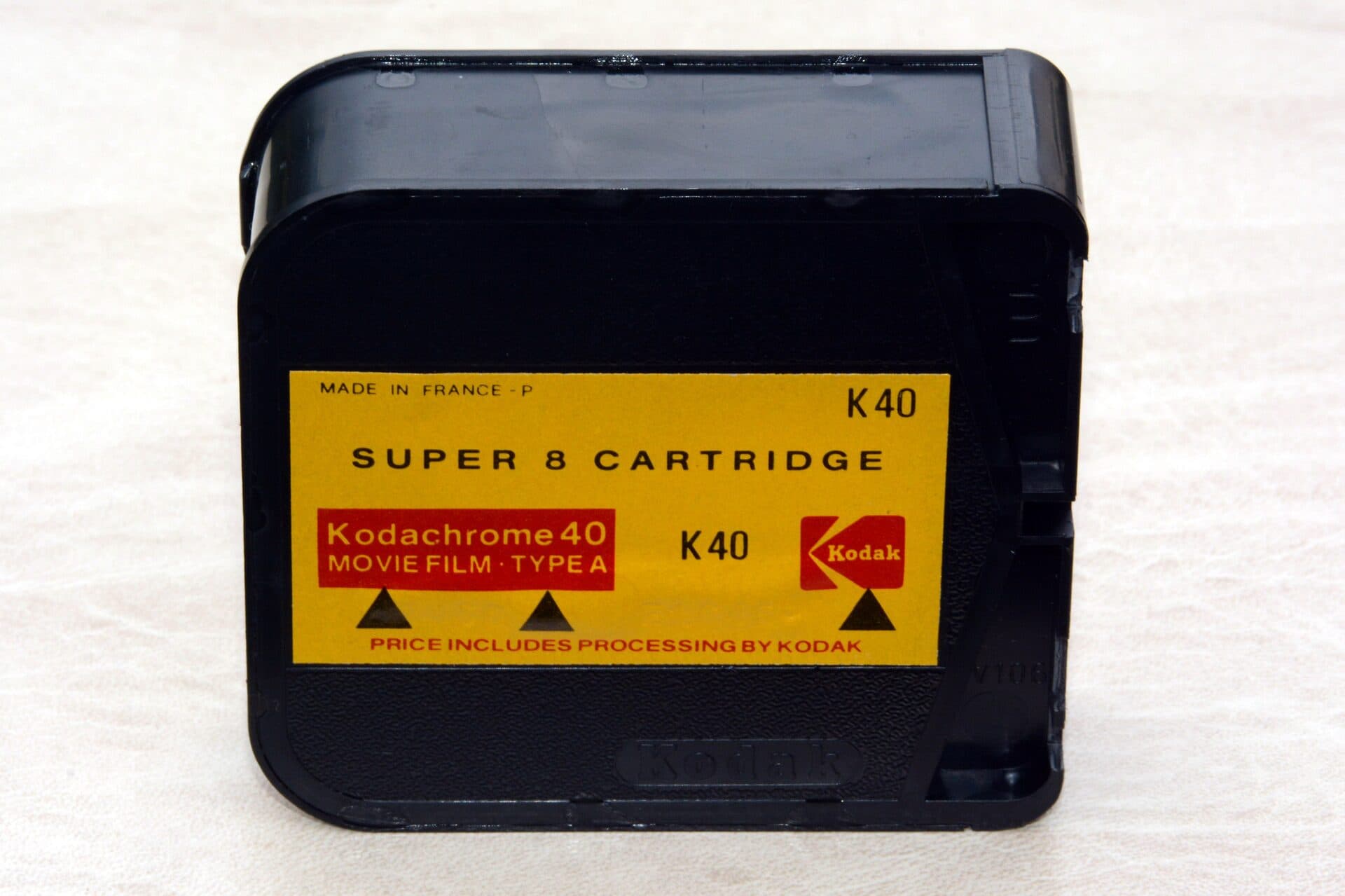
Regular 8 / Double-8 (Kodak, 1932) is clever to the point of absurdity. It is 16mm film with twice as many perforations, shot down one half of the frame, flipped, shot down the other half, and then split down the middle in the lab to yield two 8mm strips that are spliced end-to-end. The final frame is roughly 4.8 × 3.5 mm, with perforations at the frame line rather than inside the image. Super 8 (Kodak, 1965) abandoned that trick: it is genuinely 8.00 mm wide, with smaller 0.91 × 1.14 mm perforations at 4.234 mm pitch, one per frame, centered along one edge, and a larger 5.79 × 4.01 mm image about 50% bigger than Regular 8. Super 8 ships in a coaxial plastic cartridge, with an optional magnetic sound stripe on the non-perforated edge.

Super 8 format diagram (Wikimedia Commons).
Single-8 (Fujifilm, 1965) is Super 8's polyester-base twin. Same film and frame dimensions, different cartridge (coplanar side-by-side reels rather than stacked coaxial), thinner base. Single-8 cartridges fit only Fuji cameras, but the developed film is physically interchangeable with Super 8 for projection. Fuji ended Single-8 production in 2009 and processing in 2013.

Kodak Kodachrome 40 Type A Super 8 cartridge (Wikimedia Commons).
The obscure children: 9.5mm, 17.5mm, and 28mm
Three formats deserve special attention for the oddness of their border geometry.
9.5mm Pathé (Pathé Frères, 1922) is the most inventive small-gauge format ever built. Its perforation is unique: one hole per frame, placed centrally in the frame line between exposures, not on the edges. The result is that an 8.5 × 6.5 mm image fills almost the entire 9.5 mm width, giving a frame area nearly equal to 16mm on much less film. Pathé even patented a lateral notch system: a single notch on an intertitle frame would trigger a projector tensioner to hold that frame in the gate for about three seconds, turning one printed frame into forty-two frames of screen time. Sound 9.5mm arrived in 1938 with the Pathé Vox projector, adding a 1 mm-wide optical track. Over 300,000 9.5mm projectors were sold; a small French enthusiast community still exposes and prints the format.

9.5mm Pathé with center-line perforation (Wikimedia Commons).
17.5mm is not a single format but at least eight, all using half-width 35mm film. The most important is Pathé Rural (1926, home "Rex" 1932): an educational/community format with a 9 × 12 mm silent frame, one perforation per frame on each edge, at 9.5 mm pitch. Pathé Rural sound (1932) gave up one row of perforations for a variable-area optical track, narrowing the image to 11.3 mm. Other 17.5mm formats — Birtac (1898), Biokam (1898, another center-perf design), Ernemann Kino (1902), Movette (1917), and professional 17.5mm magnetic "full-coat" dubbers — share only the film width.
28mm safety film (Pathé, 1912), known as "Pathé-Kok," was the first mass-market non-flammable home cinema format, predating 16mm by a decade. Its most distinctive feature is the asymmetric perforation of release prints: three perforations per frame on one edge, one on the other. The asymmetry was patent-protected and made reverse loading mechanically impossible, though it also meant only Pathé-licensed projectors could show Pathé-Kok prints. Camera negative stock was symmetric (three perforations each side, 5 mm pitch) so camera pulldown claws could engage evenly. The image is 19 × 14 mm, which is large for a home-gauge format. Production stopped in Europe during World War I but continued in North America until about 1920.
Subminiature: Minox, Tessina, and the 9.2mm myth
Below 16mm lies subminiature. A world of cigarette-lighter cameras and spy gear. The dominant format is Minox (Walter Zapp, 1936), with a 9.2 mm film width and an 8 × 11 mm frame. The film is unperforated; advance is handled by a mechanical counter. Minox film is not 9.5 mm, despite decades of published errors and seller descriptions. Zapp intentionally specified 9.2 mm to keep the format proprietary and incompatible with 9.5mm Pathé cine stock.
Other subminiature formats include Minolta 16 (10 × 14 mm on double-perforated 16 mm cine stock; later 12 × 17 mm on single-perforated 16 mm for the MGS and QT models), Tessina (14 × 21 mm on specially-spooled 35 mm film running transverse to the lens axis, so negatives come out mirror-reversed and must be flipped at printing), Kiev-30 (10 × 14 mm on 16 mm, Soviet), and Narciss (14 × 21 mm, the smallest SLR ever made). The Robot camera used 16×16 mm on unperforated 24mm-wide 35mm-derivative film; the Echo 8 cigarette-lighter spy camera produced 6×6 mm frames.
A footnote with a smell: the 70mm Smell-O-Vision print
Scent of Mystery (1960), directed by Jack Cardiff and produced by Mike Todd Jr., was shot in Todd-AO 65mm and distributed on 70mm prints carrying a normal 6-track magnetic soundtrack. What Todd and the Swiss inventor Hans Laube added was not a new film border but a secondary signaling layer: cue pulses recorded on (or synchronized with) the magnetic soundtrack triggered a seat-side mechanism called the "Smell Brain," a motor-driven belt of thirty perfume canisters whose membranes were pierced by needles on cue, releasing the scent through plastic tubing to vents under each seat. There was never a dedicated odor track printed on the film itself. The system opened in exactly three theaters; the scents arrived late, unevenly, and with audible hissing; the film was later re-released silent, in Cinerama, as Holiday in Spain. It remains the only motion picture ever exhibited in Smell-O-Vision, and a useful reminder that the border of a film format is not always visible.
Reading the rebate: contact sheets as archaeology
The contact sheet is where all these borders become legible. A print made by laying negatives directly on photographic paper under glass reproduces the rebate exactly: perforations, frame numbers, manufacturer imprint, fog margins, all of it. Format becomes immediately diagnostic. A single row of eight rectangular sprocket holes per frame: 35mm still. Three rows of four strips with no perforations and printed frame numbers: 6×6 on 120. A square strip with one small round hole at the corner of each frame: 126. A center-perforated strip: 9.5mm Pathé (you have probably never seen this on a contact sheet, but if you do, you will recognize it immediately). A strip of tiny 8×11mm exposures: Minox.

B&W 35mm contact sheet with full rebate visible (Wikimedia Commons).
The aesthetic of the visible rebate has its own lineage. Henri Cartier-Bresson insisted on printing full-frame with the black edge as a warrant against cropping. For him the black border was ethical as well as compositional. Richard Avedon and Garry Winogrand both filed out their negative carriers so the rough filed edge of the metal printed around the frame, leaving an unmistakable brushed-black border that signaled "this is the complete negative, nothing has been removed." Ralph Gibson, W. Eugene Smith, and later a generation of art photographers adopted the filed-carrier look; by the 1980s it had become a cliché of editorial photography and by the 2000s an Instagram filter. The "bleeding" or "ragged" border (printed with the rebate and the fogged edge beyond it) remains a contemporary marker of craft, a way of publishing the negative's physical authenticity alongside its image.
For working photographers, the rebate is also a tool. Frame numbers let you find a specific exposure from the contact sheet without unsleeving the negative. Edge imprints let you date and identify stock from old rolls whose labels have rotted away. Notch codes on sheet film let you load holders in a dark tent by touch. Sprocket geometry lets you tell BH camera negative from KS print stock at a glance, which is useful if, for example, you have inherited a box of uncut 35mm film from an estate and need to know what machine will accept it without tearing itself apart.
The frame is the format
Every format in this article solves the same problem — how to transport a strip of emulsion past a lens steadily enough to make a picture — and every format solves it differently. The Bell & Howell perforation is precise and fragile. The Kodak Standard is tough and forgiving. The 9.5mm center-perf is economical. The 28mm asymmetric perforation is a patent lock. The 126 single square perforation is a consumer simplification. The APS magnetic coating is a data track masquerading as an emulsion backing. What we call "the border" is the archive of those decisions. A physical manifest, in negative, of every engineering trade-off the industry has ever made. To print it full-frame, with the rebate intact, is not a stylistic tic. It is a form of intellectual honesty: the photographer showing the negative exactly as the camera released it, including the margin where the machinery gripped.
For the working photographer in 2026, this genealogy is also a working reference. When you load a sheet of 4×5 in the dark, the notch is your identifier. When you print a 120 contact sheet, the rebate tells you the emulsion. When you scan old 35mm negatives, the perforation shape dates the stock. The borders are not waste. They are the format itself, and learning to read them is part of what it means to take the craft seriously.
Sources & Further Reading
- SMPTE RP 40, ST 59, and related motion-picture film standards
- ISO 1007 (135-size film) and ISO 732 (120/220 roll film)
- Kodak Technical Publication H-1 (Motion Picture Film) and P7-4A (sheet-film notch codes)
- Ilford Notch Codes Guide PDF
- Wikimedia Commons film-format diagrams (used as illustrations above)
- Dominic Case, Film Technology in Post Production (Focal Press)
- Barry Salt, Film Style and Technology (Starword)